A merchandise buyer approves an embroidered tag on a desk. When the sample goes on the actual backpack, the clasp barely fits over the zipper pull and the logo hangs sideways. The embroidery is fine. The attachment was chosen without checking what it had to clip onto or how the finished tag would hang.
Choose embroidered keychain hardware based on what the customer will do with it. Start with a split ring for keys, a lobster clasp for a bag charm people will move between bags, or a swivel hook when the tag needs to turn at the joint. Then test the hardware on the actual item before approving the bulk order.
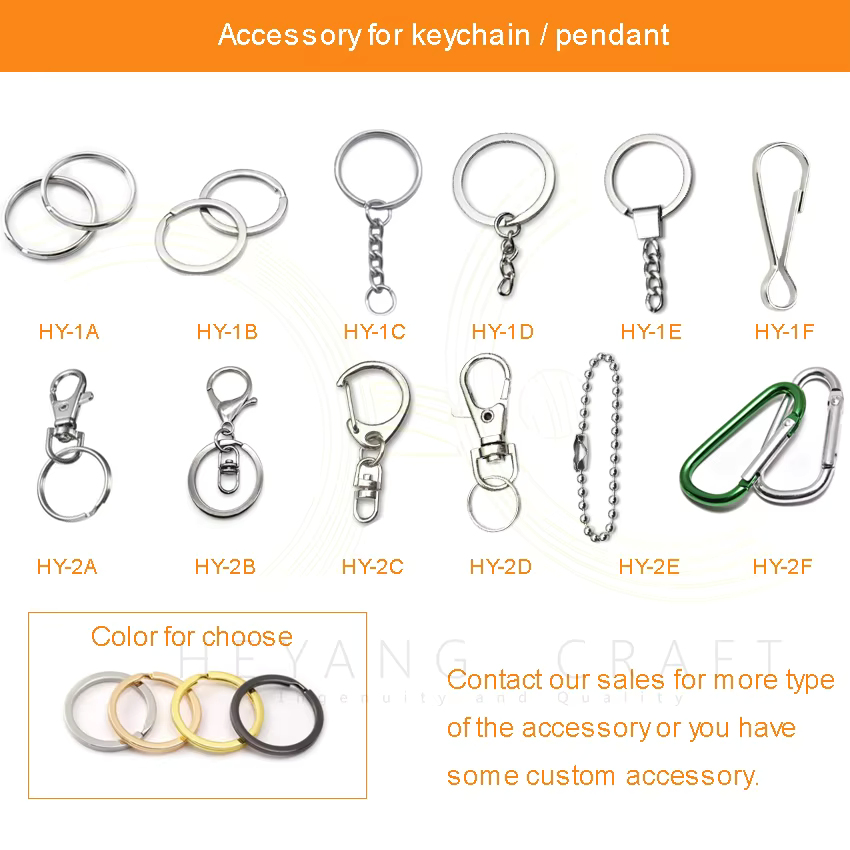
In the hardware chart above, compare the split ring (HY-1A), lobster-style clasp assembly (HY-2B) and swivel hook (HY-2D).
| Hardware |
Where to start |
What to check on the sample |
| Split ring |
House keys, locker keys and souvenir key tags |
Ring diameter, wire thickness and how easily the intended key threads on |
| Lobster clasp |
A detachable charm for a zipper pull or bag loop |
Clear gate opening, room inside the clasp and whether the gate closes fully |
| Swivel hook |
A clipped tag that needs to turn without twisting the attachment loop |
Gate fit, free rotation with the tag installed and how the logo hangs |
Split rings for keys
A split ring holds a key by letting you thread it between the overlapping turns of the ring. If the keychain will mainly hold keys, try a split ring first. Give your supplier the intended outside diameter and ask them to confirm wire thickness. Two rings with the same outside diameter can feel different when you open them. A thick key head or a small keyhole can also make a ring awkward to thread, even when the ring looks big enough.
Use the thickest key you expect the ring to carry and check that the turns close back together after fitting. If the keychain ships on a retail card, confirm where the assembled ring sits so it does not cover the logo or interfere with the card slot.
Lobster clasps for detachable bag charms
A lobster clasp has a spring gate you can open to clip the tag onto a zipper pull, D-ring or bag loop. Measure the clear opening with the gate fully open and check the space inside the clasp once it is shut. Overall clasp length tells you little about either measurement.
For example, if a rigid round D-ring is 6 mm thick at the clip point and the clasp has a 5 mm clear gate opening, that clasp cannot pass over that section. These are example dimensions. For your order, use the actual bag or a matching piece of hardware and check that the gate snaps fully shut once clipped on. If the attachment point is folded webbing, test the whole fold and make sure it does not catch in the gate.
Swivel hooks when the tag needs to turn
A swivel hook has a rotating joint between the hook and the tag attachment. That joint lets the tag turn independently of the hook. It does not determine which face stays visible. For a single-sided logo, hang the assembled tag on the actual bag, turn it over and let it settle. Check whether the artwork reads upright and whether a second decorated face would make sense.
The terms lobster clasp and swivel hook can overlap. One describes the clasp or gate style, and the other highlights the rotating joint. A lobster-style clasp can come with a swivel. Send a reference photo and ask the supplier to mark the gate and the joint on the proposed part. Example keychain hardware assemblies
Specify how the hardware attaches to the fabric
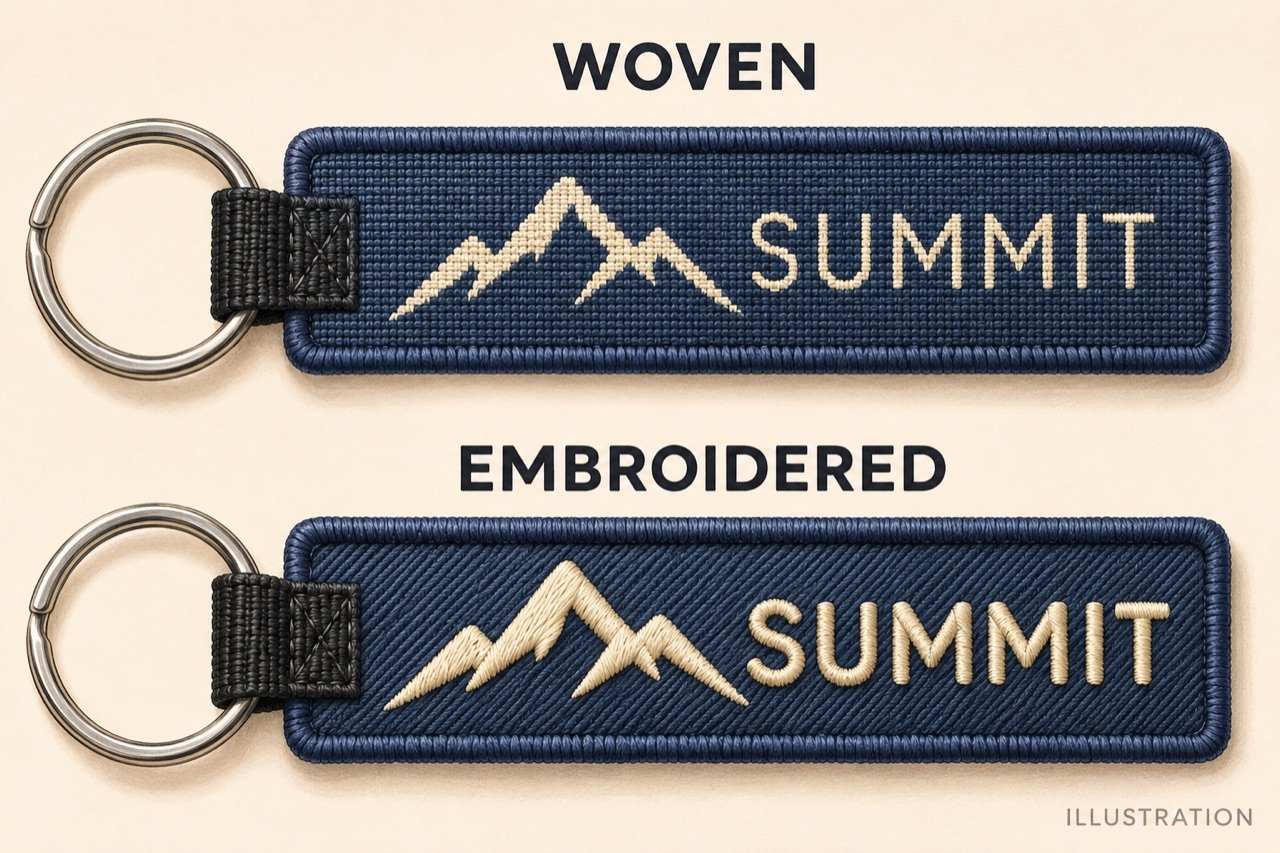
The hardware the customer uses and the way it joins the embroidered tag are two separate decisions. For a sewn webbing loop, check the stitching and whether the hardware has enough room to move inside the loop. For a metal eyelet, also called a grommet, check that it sits flat, has no sharp edges and leaves space around the stitched border and any nearby lettering. If the assembly includes a small connector ring, inspect that part as well. Examples of fabric-loop and grommet assemblies
To compare prices, give suppliers the same artwork, tag size, quantities and packaging. Ask them to list each hardware option separately and identify the parts it includes. Use the bulk quote guide for the rest of the brief.
Before approving the sample, record:
- Fit: The intended key or bag attachment fits, and the clasp or split ring closes properly.
- Movement: The assembled parts move as intended without pinching the fabric or snagging stitches.
- Appearance: The finish matches the approved reference, the hardware clears the logo, and the tag sits correctly on any retail card.
- Production reference: Keep the approved sample ID, hardware part number or photo, dimensions, finish and connection method with the purchase order.
Frequently asked questions
Can a keychain have both a split ring and a clasp?
Yes. A split ring can hold the keys while a clasp clips the assembly to a bag. Show the order of the parts in your brief and review the total length and movement on the sample.
Does a swivel keep the logo facing forward?
A swivel lets the tag turn. If customers need to see the logo from either side, consider decorating both faces and check the layout on a hanging sample.
What should I send for a hardware quote?
Send front and back artwork, tag dimensions, quantity by design, finish, a photo or measurement of the intended attachment point, and the preferred hardware and fabric connection. Include packaging and delivery destination. Visit custom embroidered keychains and select Get a Bulk Quote to send your brief.