A keychain can be approved while its packaging is still undecided. That gap often appears when the buyer starts preparing a retail display, sorting event giveaways or booking warehouse delivery. The ring may extend beyond the chosen card, the label may identify the wrong design, or the receiving team may need to count loose units again.
Quick choice: which embroidered keychain packaging should you request?
Consider bulk packing when your team will sort or distribute the items. Request individual bags when each unit needs separate handling. Choose a backing card when branding, product information or display presentation matters. Confirm the complete packed sample, including its hardware, before approving the packing specification.
1. Start With How the Keychains Will Be Received
Describe what happens after the carton is opened. A retailer may need each keychain ready for display. An event team may want counted groups for a registration desk. A distributor may need separate design codes and quantities for several destinations.
These are different packing jobs even when the keychain design is identical. Decide who will unpack, count, label and display the items. Include that work when comparing quotations; a lower packing charge may leave more preparation for your own team.
Heyang Gift’s custom embroidered keychain product page lists polybags, backing cards, gift boxes and custom packing options. Ask which combination is suitable for your project and what is included in the quoted price.
2. Compare Bulk Packing, Individual Bags and Backing Cards
Packaging Choices for a Bulk Keychain Order
Option
A practical use
Confirm before approval
Bulk packing
Counted groups for further assembly, event distribution or repacking.
Units per group, separation between styles and how the hardware is contained.
Individual bag
One unit per pack for separate handling or distribution.
Usable bag size, closure, label location and whether the ring fits without stressing the seal.
Backing card
A branded presentation with space for product information.
Card dimensions, printed sides, attachment method, display needs and any outer bag.
Gift box or custom pack
A presentation brief that requires a defined opening or arrangement.
Internal fit, movement inside the pack, assembly work and packed shipping dimensions.
These options can be combined. A backing card does not automatically include a bag, and an individual bag does not automatically include a printed label. Write the complete combination into the purchase specification.
3. Size the Pack Around the Keychain and Its Hardware
Measure the assembled keychain, including the split ring, clasp or connector. The textile length alone is not the full packing footprint. Check the position the hardware will occupy rather than assuming it will lie flat wherever there is space.
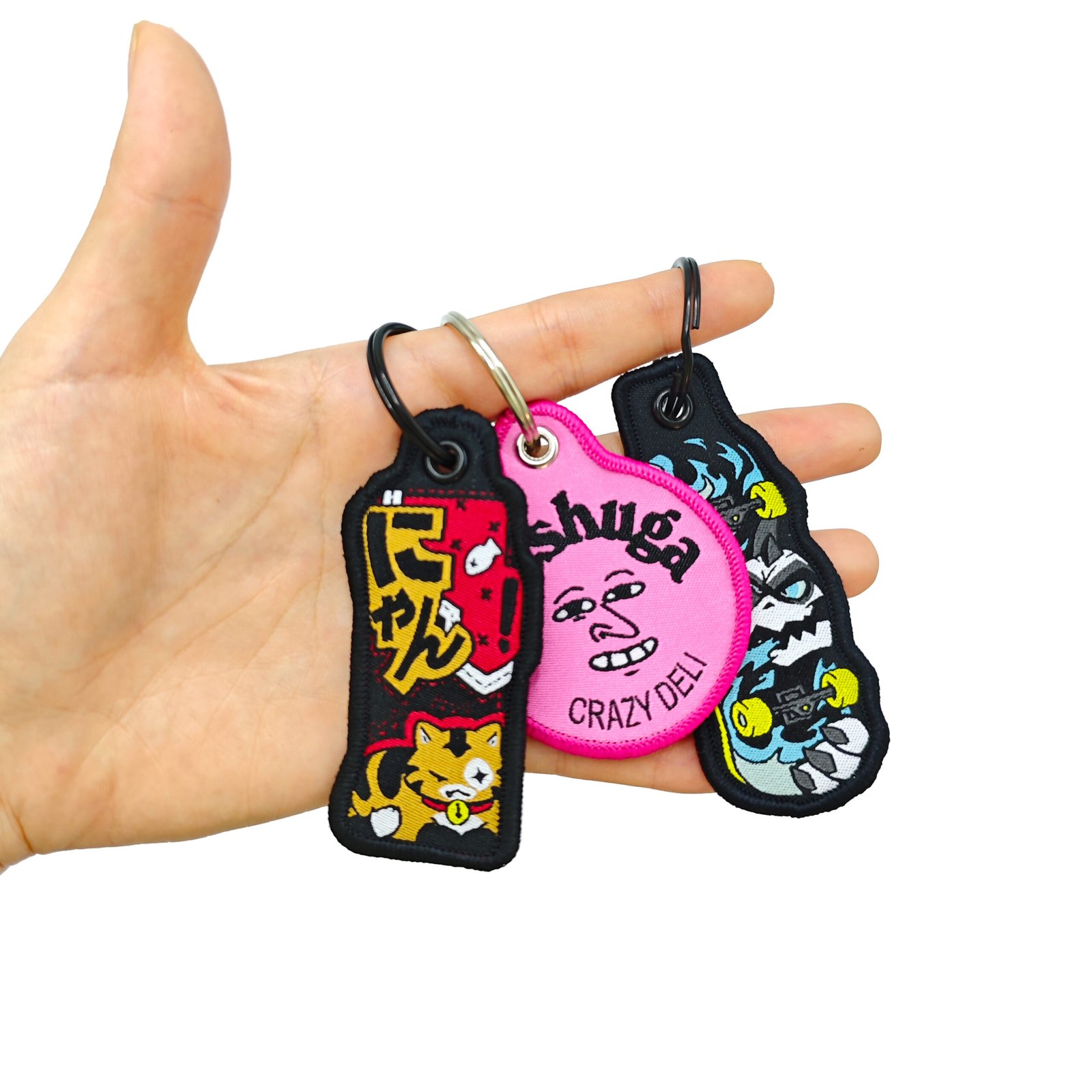
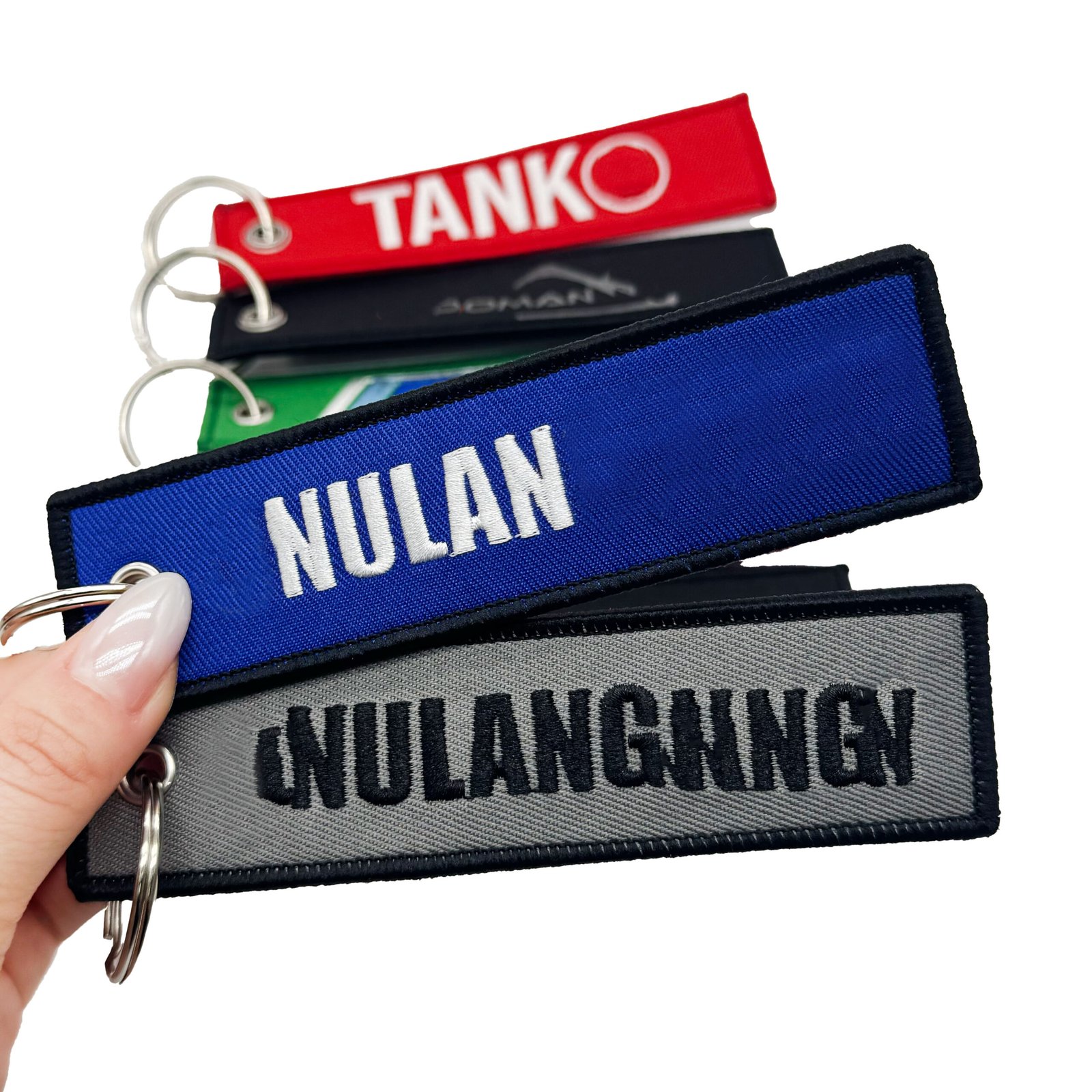
Existing product examples from the Heyang Gift website. Different outlines and ring positions need different packing layouts; this photograph does not show a packaging sample. For a card, specify its finished dimensions, orientation and how the keychain will be held. If it will hang on a shop fixture, provide the fixture requirements and check a packed sample on that fixture. Ask the supplier for its print template before finalising artwork.
For a bag, confirm the usable internal space and closure arrangement. For a box, check the internal fit as well as the outside dimensions. Do not select every size from an enlarged screen image. The hardware guide can help define the attachment that must fit inside the pack.
4. Approve the Card Artwork and Product Identity Together
Give the keychain, card and label a shared style code. Check the logo, wording, printed sides and artwork revision before printing. If the card covers one face of a double-sided tag, decide which face the customer should see first and confirm that position on the sample.
If a barcode is required, provide the correct code, label content and retailer or warehouse requirements. Do not ask the supplier to invent a product identifier. Check that the code matches the style and can be scanned with the intended system in its final packed position. Keep the ring, folds and closure clear of the code area.
Use the front-and-back artwork checklist to settle the keychain design first. Packaging approval should then confirm how that approved product is presented.
5. Put Quantities and Carton Labels in Writing
Separate the total order quantity from the packing breakdown. As a planning example, 300 keychains could contain three styles of 100 pieces each. If each style is grouped in lots of 25, the packing list should show four groups per style. These numbers illustrate record keeping; they are not a minimum order or standard carton capacity.
State whether styles may share an outer carton. Agree on the information needed on group labels and carton marks, such as the purchase order reference, style code, quantity and carton number. Match the packing list to those labels so receiving staff can identify the contents without opening every individual pack.
Confirm the final packed carton dimensions and weight for freight planning. A quotation based only on loose product dimensions does not describe a carded or boxed shipment.
6. Review a Fully Packed Sample
Approve the product inside its proposed packaging, not just an empty bag or a card design. Review these points before the bulk packing run:
The correct keychain style is paired with the correct card and label.
The logo and intended display face remain visible.
The ring or clasp is secured as agreed without pulling at the stitching or deforming the card.
The pack opens as intended and the closure is not under strain.
Any barcode can be scanned in its final position.
The grouping, labels and packing list use the same style codes and counts.
Keep photographs of the approved arrangement and a physical reference where fit or handling matters. If shipping protection is a requirement, agree on the evaluation method and acceptance criteria. An attractive packed photograph alone does not establish transit performance.
Request an Embroidered Keychain Packaging Quote
Send your keychain artwork, finished dimensions, hardware choice, quantity per style and preferred packing combination. Include card or label artwork if available, the intended display or receiving process, destination postcode and required arrival date.
Heyang Gift’s keychain page lists a 50-piece minimum order. Confirm how the minimum applies to your designs and whether printed packaging has separate quantity or preparation requirements. Request product, packaging materials, printing or setup, packing labour, samples and freight as clearly identified costs. The bulk cost guide explains the wider quotation scope.
Send your keychain and packaging requirements for a quotation .
Frequently Asked Questions
Are backing cards included with embroidered keychains?
Only if the quotation specifies them. Confirm the card dimensions, printing, attachment method and whether an outer bag is included.
Can different designs be packed separately?
Request a packing breakdown by style, quantity and destination where relevant. Ask the supplier to confirm the separation method, labels and any associated packing charge before ordering.
Does a 50-piece keychain minimum also apply to printed packaging?
Do not assume so. The product minimum and the requirements for printed cards, labels or boxes must be confirmed separately in the quotation.